Laptop
May 29, 2019
The best Chinese laptops for every taste and wallet
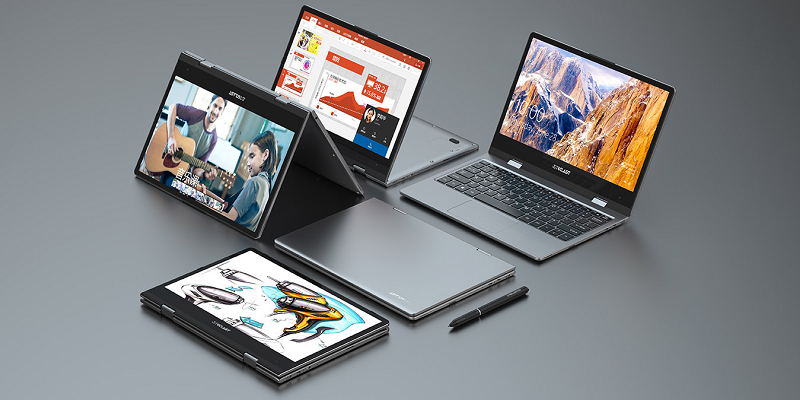
Chinese smartphones and tablets have long ceased to be something unusual - the solutions of the brand "top for your money" can be found everywhere. But laptops from China are still some curiosity: hearing, perhaps, only solutions from Xiaomi and Huawei, and this is just the tip of the iceberg, there are manufacturers like Jumper, Voyo, Chuwi and many others, about which an ordinary user PC did not even hear. So today we will just talk about Chinese laptops and see which ones are worth taking.
Jumper EZBook 3 Pro and X4 - basic level
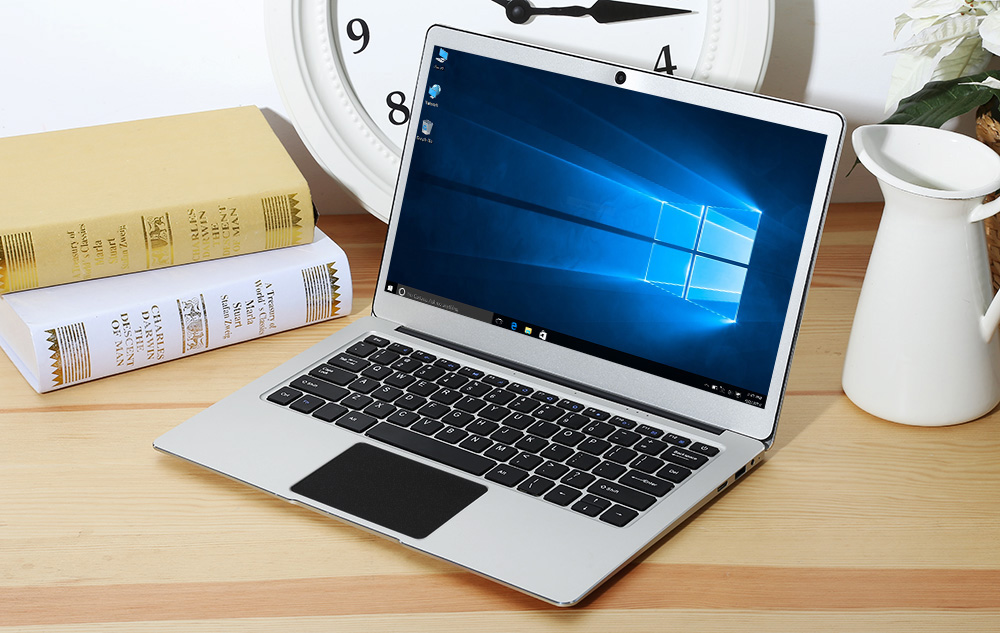
Yes, the basic level is exactly that, despite the fact that laptops can be found for 9.5-10 thousand rubles. Why? It's simple - cheaper models are full noname, often going even without all the drivers. There is no need to talk about minimum quality control there, so I strongly recommend not taking them.
Therefore, the simplest laptops from Jumper can be considered the minimum level. Yes, you have hardly heard about this company, but for more than three years it has been releasing various mobile solutions, and in the 3rd and 4th versions of the “childhood” illnesses are already gone. For an amount of 15-20 thousand rubles, you will get a quad-core Intel Celeron with integrated graphics, 6 GB of RAM and a 64-128 GB drive. The screen diagonal is 13.3-14 ", resolution - 1920x1080, while the matrices themselves are made using IPS technology. The weight of these models is about 1.5 kg, while you can count on at least 6 hours of work on the Internet.
The performance of this solution even to the base Intel Core is far away, but with surfing the Internet, watching videos up to 1080p60 and working with documents it will be enough without any problems, and given the small weight and good autonomy, you can easily take it with you on the road. There are also more expensive versions with 8 GB of RAM available - there is no point in taking them, office tasks do not need that much, but Celeron is not capable of anything heavier.
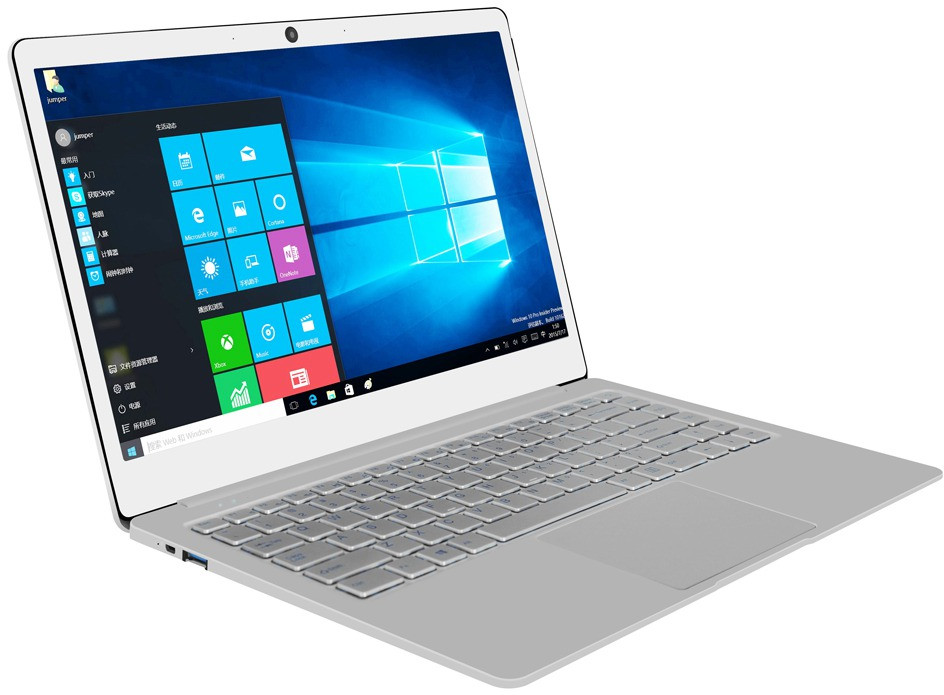
Screens also make you happy - brands offer FHD TN for the same amount at best, IPS matrices are already there. Of course, they do not shine with perfect color reproduction and high brightness, but, nevertheless, they are much nicer and brighter than most branded laptop screens somewhere up to 25-30 thousand rubles.
But the ports are not very good: if two full USB 3.0 questions do not cause, then miniHDMI and a slot for microSD are somewhat surprising - there would be enough room for full connectors in the case without problems, so in the end you will have to use a laptop to connect to a TV adapter. But on the other hand, the EZBook 3 Pro has a significant advantage - the ability to install another 2242 SSD, which allows you to get storage of almost any desired volume.
Also for this money there is a model CHUWI LapBook SE - the company is quite known for its good tablets on Android and Windows. This model is very similar to the EZBook 3 Pro, but still somewhat worse: so, it has 2 GB less RAM, and at the same time it costs an average of 1-2 thousand rubles more, so I see no reason to consider it for purchase .
CHUWI AeroBook 13.3 and Teclast F6 Pro - “almost a MacBook 12”
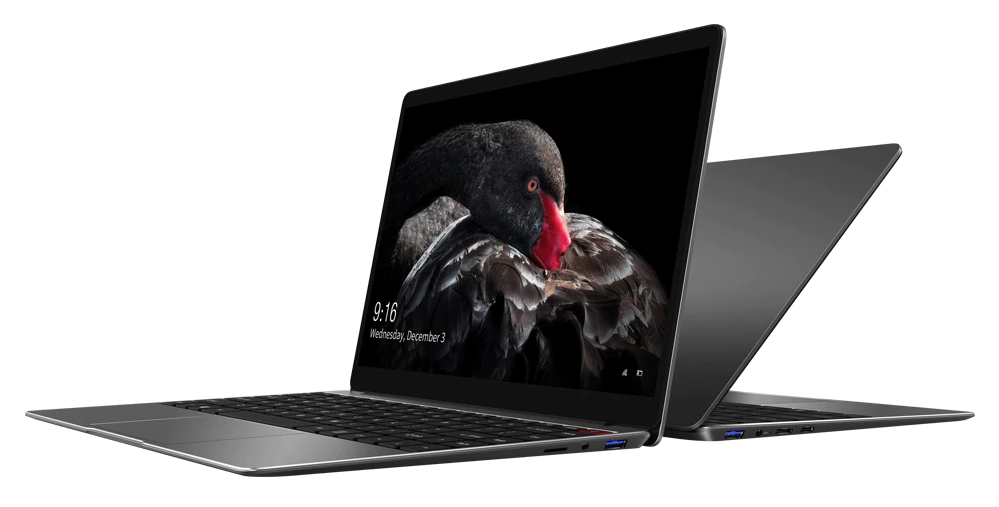
Actually, something radically new starts from about 30 thousand rubles - for this money, the first models appear on Intel Core m3 processors. They are significantly faster than popular cheap Celeron, especially when it comes to graphics, where the gap is often threefold. You most likely met these CPUs in a 12 "MacBook, so the level of performance is understandable here: surfing the Internet, watching videos up to 4K and playing simple games of any complexity. Simple processing of photos and videos is also in the teeth.

With such CPUs, two interesting models can be identified - it is Teclast F6 Pro, which is also a transformer, and has 8 GB of RAM and 128 GB SSD, which can be called the optimal minimum (by the way, it is possible to install another 2242 drive). The second model is CHUWI AeroBook: it costs a couple thousand more and is not a transformer, but it already offers 256 GB SSD with the same amount of RAM. All other characteristics are similar: 13.3 "IPS FHD-display, a pair of USB with miniHDMI, battery for 5-6 hours of operation and weight slightly less than 1.5 kg.
Why is there no Xiaomi NoteBook Air 12.5"? The reason is trivial - for a little more compactness you will have to pay about 5-7 thousand rubles, and also lose 4 GB of RAM, which is already critical in this case. Is it worth it? More likely no than yes.
Kingdel 6500U - a three-year-old top-end ultrabook

If you heard about Chuwi and Teclast at least those who were interested in cheap Android tablets, you know little about Kingdel outside of China, and the PC company has been in vain since 2005 , more than 5 years on AliExpress and specializes in mini-PCs and ultrabooks. At the same time, many of their solutions have no names, so you need to look for this laptop on Ali as Kingdel 6500U, that is, by processor.
Specifically, this model is interesting because it offers iron for relatively small money, which was installed in top ultrabooks a couple of years ago: these are dual-core Core i7-6500U / 6600U with a frequency above 3 GHz, 8-16 GB of RAM, 128-512 GB SSD (HDD installation possible) and Nvidia GT 940M discrete entry-level video card. Such a device can already be considered a good working machine - and it will cope with video processing, and you can play games 3-4 years ago, not to mention surfing the Internet and watching videos where there are absolutely no problems.
Everything else is iron, perhaps, quite standard for a good ultrabook: 15.6 "IPS FHD-display, a pair of USB 3.0 and HDMI, weight 1.85 kg and a battery for 5-6 hours of operation. The only complaint to this laptop is an unsightly appearance, often solutions from the same CHUWI look much more interesting. But if the main thing for you is the price-performance ratio, then this ultrabook is very good.
Xiaomi Mi Notebook Air 13.3 and Huawei Honor MagicBook 14 are premium compact Chinese ultrabooks

In this price segment, noname is no longer - Xiaomi and Huawei have heard about it for many (and yes, Windows 10 will work and be supported on the last laptop). Both notebooks above are quite similar: 8 GB of RAM, 256 GB SSD, thin metal cases, fingerprint sensors, FHD IPS-displays. Even they live from the battery the same, about 6 hours.
Basically, the difference is in the processor and RAM: if Xiaomi, which costs 3-5 thousand more, offers 4-core Core i5 and discrete Nvidia MX150, then AMD offers 4-core Ryzen 5 and integrated Vega 8. And here is the whole choice lies in the way you plan to use a laptop: if there is nothing heavier than Photoshop, it will not make sense to overpay for Xiaomi. But if you plan to play, it will be better here, because the MX150 will allow you to launch most of the new igroprom products, albeit at minimum settings.

Also for this money, there is a Xiaomi Mi Notebook Ruby - a simplified version of the 15 "Mi Notebook Pro. Alas, even if you don’t take a case that has become partially plastic, the graphics performance seriously suffered: the MX110 video card used is two times weaker than the MX150 and loses one and a half Vega 8, so it makes little sense to make such a decision:
Xiaomi Mi NoteBook Pro and Huawei MateBook X Pro are top Chinese ultrabooks

So we got to the top Chinese ultrabooks, and yes, there is again only Xiaomi and Huawei. They are quite similar in hardware - these are 4-core Intel Core processors of the last two generations, 8-16 GB of RAM and SSD up to a terabyte. There are some differences in graphics: the base level is the MX150 or MX250 (essentially no different), but the second version of the Xiaomi notebook already has the GTX 1050 Max-Q, which will not just allow at least some modern games to run, and play them comfortably. The battery life also can not but rejoice - you can count on at least 6-7 hours of surfing the Internet.

At the same time, the solution from Huawei is significantly more expensive, and there is a reason for that: first, there is a display installed at a resolution of 3000x2000 pixels versus 1920x1080 for Xiaomi, which gives a picture comparable in definition to that on the iPad. Secondly, the Huawei laptop has a Thunderbolt 3 port, which significantly expands the possibilities for connecting devices - for example, you can buy a docking station with a high-performance video card (even RTX 2080 Ti) and connect it to this ultrabook, improving graphics performance at times. It should be borne in mind that the solution from Huawei is smaller and lighter, which is not surprising, because there is installed a 13.9 "screen against 15.6" for Xiaomi.
MAIBENBEN DAMAI 6S and Hasee K670D - basic gaming laptops

The basic gaming graphics card at the moment can be considered the Nvidia GTX 1050: it allows you to play FHD in most games at least with average graphics settings and at least 30 fps. And among Chinese laptops it is quite common, but there are only two interesting models from Maibenben and Hasee.
The first of them, perhaps, does not stand out: 4-core notebook Core i5, 8 GB of RAM, SSD for 240 GB - similar hardware can be found in gaming laptops for about 50 thousand rubles, so you can win about 5 thousand, which is enough not bad. In this case, the laptop is also quite easy for a 15 "solution - just 1.9 kg. The only minus is the TFT TN matrix, but for a gaming laptop of the lower price segment, which is not bad.
But Hasee is surprised by its hardware: if 8 GB of RAM and 256 GB SSDs are quite common, then a desktop 2-core Pentium can be found in laptops a little more often than never. But, unfortunately, it is soldered here, as in the Mac mini, so replacing it with something faster will not work. In general, this notebook loses the processor Maibenben (although it is quite enough for such a video card), but it benefits from an IPS display, and the price tag is 3-4 thousand lower, which makes it the cheapest GTX 1050 notebook on the market.
MECHREVO X8Ti Plus - the most affordable laptop with Core i7 and RTX 2060

Of course, the question may arise: where is the Xiaomi Gaming Laptop and the various models from BBen and Thunderobot? The answer is simple: after the release of Nvidia’s RTX 2000 video cards, prices for GTX 1000 solutions in Russia went down sharply, and as a result, they are often even cheaper than notebooks from Chinese brands with similar performance and without a guarantee, which makes the purchase of the latter meaningless .
But here new solutions for RTX 2000 from China still turn out to be much “tastier”: the truth is, there are so few of them, and there is only one interesting model from Mechrevo. It has a 6-core Core i7, 16 GB of RAM, Nvidia RTX 2060, 256 GB SSD and 1 TB HDD, and 17.3 "FHD 144Hz IPS display and mechanical keyboard become the cherry on the cake: in general, analogs they cost significantly more than 100 thousand rubles in the CIS countries, so this model turns out to be quite interesting (especially if you ask the seller to indicate the value below $ 500 in the customs declaration).
As a result, as you can see, laptops from the Celestial Empire cover almost all segments of the market: mainly orientation goes to ultrabooks, but there are also enough game models. Of course, almost all of them require a good knowledge of at least Windows to set them up, but if you’re on computers, you can easily get yourself a good mobile assistant much cheaper than its counterparts in Russia cost.